WHEN JOBS COLLIDE

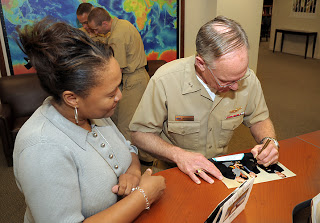
Phil Irey, lead computer scientist at the Dahlgren Division of the Naval Surface Warfare Center, explains to Department of the Navy officials the Office of Naval Research's suite of information technology tools designed to improve fleet operations during a series of experiments at the Integrated Warfare Systems Laboratory in Dahlgren, Va.
Taking charge early during an assignment allowed me to get my photographs, clear them with local security officials and make it to the airport for a flight that afternoon to next assignment.
The purpose of this post is not to show how busy I am, but rather to offer a few tips on moving things along and taking charge.

A glimpse at last week's calendar would have shown Monday free, several assignments on Tuesday (turned into six, all with end-of-day deadlines), Dahlgren Va., on Wednesday and Panama City, Fla., Thursday. Vacation started Friday. First thought is why does it always seem that vacation interferes with work, second thought, I'm not going to miss first vacation I've taken this year.

How to prioritize? Which job can you cover and which can be contracted out? What is most important to your employer? All these questions need to be answered.


I needed to be in Florida to conduct interviews at the Navy Experimental Diving Unit first thing Thursday morning. This was the last set of interviews and b-roll needed for an overdue undersea medicine video that had an original deadline of December 1st. So I couldn't push that back any further and in order to be there in the morning meant having to fly out Wednesday night. And Panama City isn't the most convenient destination, so best option was BWI on the last flight, 4:50 p.m.

The job in Dahlgren was to photograph a demonstration of a suite of information technology tools at the Integrated Warfare Systems Laboratory. Not the sexiest of assignments and due to both security concerns and the fact that this is a software based experiment, not easy to visually represent.

The day in Dahlgren was scheduled to start at 9 a.m. with briefings, followed at 12:30 with the actual demo. So best case was that I wouldn't be able to start taking the photos I really needed until the afternoon. How would I shoot, edit, caption, and most importantly clear images through security, all before having to drive to BWI for flight? I figured I would have to be on road no later than 1 p.m.

Now you understand the situation. Option one was to rely on a Dahlgren based photographer as was proposed the previous week. And to be fair, I did reach out and speak to the photographer assigned to cover this, however, it became clear that while he would be able to photograph the event, getting timely captioned releasable images of key persons that were needed in order to match up with article being released same day was not going to happen. Plus I got the sense that this job was important to my boss. Not that they all aren't important, but sometimes you just know.

How did I pull it off? I did my best to make clear to those running the demo that I needed to be on the road by 1 p.m. I arrived at the location 45 minutes early to clear security, meet key people, and scout location(s). I also started driving the conversation on how I was going to shoot and then download images on the spot so security personnel and key program managers could review them before I left, which would enable me to transmit quickly. That is not a five minute conversation, but requires persistence and a retelling to many people until the idea sticks. It's about setting expectations.
Scientist gives a Powerpoint presentation.
Photograph taken during the morning sessions.
So after photographing presentations all morning and watching the time tick away, I was starting to think that I was not going to pull this off. Originally, the actual hands-on demo was to begin following lunch which was scheduled at noon. Now I know enough to realize that once lunch started, there was no way they were going to get everyone together for a 12:30 demo. First break of the day came when lunch did not arrive on time so I jumped at the opportunity to suggest to the coordinator that it would be a good time to start the hands-on portion with the VIPs while the others waited for lunch. What a great idea Mr. Photographer! So the demo began, I shot like crazy, left demo still in progress, downloaded and edited images, and by the time the first group returned and started eating their lunch, I was getting the images cleared. Only thing that remained was to burn a CD to leave there and I was on the road to BWI a few minutes past 1 p.m.

There are several take-aways. You can drive the events without taking over. Everyone knew that I had a hard deadline, yet I wasn't pushy. Prior preparation meant during the morning presentations, I wrote my captions, making sure I had names and titles of anyone that might make the edited images.

I finished toning, captioning and transmitting images while waiting on my flight at BWI. Made deadline and two images were published the following day.

INSPIRED

HDR photograph of Owl's Head lighthouse in Maine.
High Dynamic Range (HDR) photograph taken during a family vacation to Maine during the winter. This was the first vacation that I remember where I specifically wanted to take photographs as part of the experience.
For many years taking pictures has been my job. That's not to say I didn't like being a photographer, in fact I loved it, and still do, however over time I came to realize that the only work I had to show was related to the job. And while I am proud of that work and still get excited to see my photos in print, I had stopped taking images for the fun of it. Very little personal photography.

When someone would discover I was a photographer they would invariably ask what I liked to take pictures of, or where they could see my work and until recently the best I could offer was a website that hadn't been updated in nine years or maybe tell them to do a Google search on my name plus Navy and they would see some examples.

So what changed? What has me excited about personal photography again? Why am I blogging and tweeting again, posting photos on Flickr, 500px, and Google+? The answer isn't simple, but I do know it has something to do with the web and more specifically the incredible photographers, some young and some recognizable, out there who are sharing their work and techniques everywhere, mostly on the sites I mentioned above, but also through their blogs and videos on YouTube.

HDR photograph from the rafters of the Museum of the U.S. Navy.
Experimenting with HDR at the Museum of the U.S. Navy located at the Washington Navy Yard, Washington, D.C.
This didn't happen overnight and it's been kind of a slow return. I really started getting excited about the time that High Dynamic Range (HDR) photography was coming on the scene and I stumbled across Trey Ratcliff's stuckincustoms.com site. Trey's incredible images and willingness to share how he made them had me trying HDR techniques myself and I was hooked. It was fun to try something new. But more than that, blogs and web TV from Scott Kelby and the Photoshop guys, podcasts from Leo Laporte and the TWIT network, all had me itching to get back out there.

Joe Macnally of National Geographic and small strobe fame along with David Hobby from Strobist.com had me actually looking forward to taking environmental portraits at work again.

All this isn't really new I guess, I've been following photographers like Rob Galbraith, Dave Black and others on the web for a long time. I suppose it all just hit the tipping point and I'm glad.

So thanks to all those photographers who are so willing to share and make it easy to feel as if I'm surrounded by friends with the ability to share work, discuss work and for the inspiration to dust off my website and blog.

After 28 years in the business it really is nice to feel so inspired again.


Back-Button Focus Faux Pas

About three months ago I switched to using back-button focus on my Nikon D3S and for the most part have adapted fairly well. Although I've had a few missteps, such as yesterday when I was shooting a change of command and retirement ceremony, switching back and forth between a D700 without back-button focus set and the aforementioned D3, I just failed to focus during a cake cutting. Since I was using a 14-24 lens, I was able to recover the images in post, but it had me thinking if I should switch back.


I have also been thinking about all the other things I've changed recently such as shooting flash with the camera set to manual mode vice aperture priority mode (default setting for most of my photography) and pushing ISOs to 3200 on a regular basis. Well technology has certainly improved and my photography has improved as a direct result of these changes, but sometimes I wonder why I'm changing. After all I've been using the shutter button to set focus ever since there has been auto focus. And truth be told, setting my Nikon's to aperture priority and the flash to TTL produces fine results.

I think it simply comes down to change is good and after all why would I shoot my D3s or D700 the same way I shot with my N90 or F4 film cameras. It feels good to push myself and starting tomorrow I'm going all in and switching my D700 to back-button focus as well. One word of warning, be prepared to explain back-button focus to everyone you hand the camera to.


And speaking of my assignment yesterday, I've probably photographed hundreds of change of commands and retirement ceremonies over the years and while some are bigger, they are all pretty much the same. Yesterday's assignment also included spending some time behind-the-scenes prior to the ceremony, mostly to cover the promotion of the incoming admiral. Enjoyed that more than I thought I would and was really happy with the results. The location was Quarters E on the historic Washington Navy Yard which made a real nice environmental location and setting my camera to manual mode - along with using a SU-800 wireless Speedlight Commander - allowed me to get my SB-900 flash off camera and resulted in some nice natural looking images.


One other thing I do when shooting an event is to look for something that I find interesting or different, something that may not make it into the final edit for the client. I thought the photo below of the Washington Honor Guard crowding into the exit following the ceremony was funny.


EVERY PHOTO COUNTS

Spent the entire afternoon yesterday photographing awards presentations as my departing boss made his way around the building thanking employees for the work they have done.

It is easy to forget that while these photographs (grip-and-grins) get a bad rap and may never make it to your portfolio or website, they are important to the person being recognized. In fact, I have a photograph shot by a Navy photographer of me as a ten-year-old standing with my grandfather during his retirement ceremony from the Naval Air Development Center in Willow Grove, Pa. That photo reminds me daily to give my best during every photo assignment both big and small.

I was reminded of that yesterday as I was standing around between presentations, an employee got my attention and asked if I thought it would be okay if the admiral signed something for her after the ceremony. I told her I didn't think it would be a problem and that is when she produced a photograph I had taken of her and the Admiral in 2009 during a cake cutting to celebrate the Navy's 234th birthday.

Every photo counts!


TinEye for the next guy

I received a request a couple of weeks back from a Russian railway magazine for a photograph of robotic lobsters I took in 2005 during my first year working for the Office of Naval Research. I posted an update to this blog about the original shoot in December of that year.

I didn't realize it at the time, but that one day shoot north of Boston would produce probably the most requested photograph I've made here in seven years. Everyone from the Smithsonian's Cooper Hewitt museum to trade journals, websites and even apparently railway magazines in Russia have requested this image.

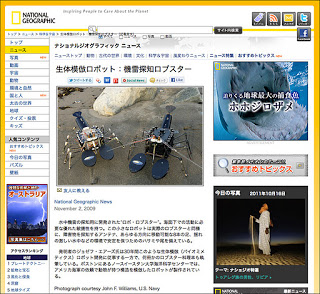
I bring this all up because I was demonstrating the TinEye reverse image search site to a coworker and happened to have the RoboLobster photo on my desktop (Russian railway magazine). I uploaded the image and one of the results was National Geographic - the Japanese edition mind you - but still I thought it was pretty funny.

Try out the service yourself, you never know? And if your images are not in the public domain like mine, and you've copyrighted them, it could mean a very nice payday as well.