BEING PUSHED CREATIVELY

Archived photograph of FLIP.
FLIP photograph from the ONR archives.
I'm preparing to leave for another assignment. Nothing very different about that except this is an opportunity I have been hoping for since I began working for the Office of Naval Research (ONR).

The research vessel FLIP, or Floating Instrument Platform, will be celebrating its 50th year of operation June 29th and I will be covering the ceremony, but more importantly, I will get a chance to photograph FLIP doing its thing at sea the next day. Now it probably won't be the most interesting thing I've photographed in the past eight years, or even the most technically challenging, however, I have always thought that FLIP was really cool.

I came close on two previous occasions to photograph this one-of-a-kind 355-foot research vessel, owned by ONR and administered and operated by the Marine Physical Laboratory at Scripps Institution of Oceanography at University of California, but both times plans changed or missions were scrubbed.

So when this opportunity arose, I made sure that I was included. One big decision needed to be made though. Would I ride aboard FLIP or with the VIPs aboard the tugboat Diana G. where I would get the best view of FLIP, well actually flipping? Tough decision, but only because I really wanted to be aboard FLIP. In the end it really seemed to be a no-brainer to ride aboard the viewing vessel if it was photos I needed.

At least I thought it was a no-brainer. In a staff meeting this week I was briefing the upcoming assignment when a co-workier asked if there weren't already a million photos of FLIP from the perspective that I would be shooting from. That really made me think and the more I thought about it the more it troubled me because she was right. What would be different about my photos? Could I have done something really creative and different if I had made the decision to ride aboard FLIP?

Too late to change my decision, which brings me to the title of this post. It will be my personal challenge to bring back something different that nobody has seen from a vantage point that many have shot from. I'll get all the standard "beauty shots," but I will really be looking around the edges to get something very different. My goal will be to return from this assignment and show that even if hundreds have photographed something before, I can produce something just a little different.

PHOTOS LEFT UNPUBLISHED

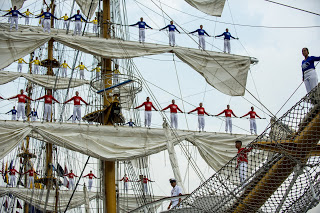
Colombian Tall Ship Gloria

Typically you cover an assignment, edit and caption photos, then when all is done, transmit your photos for publication. For me that typically means between three to five photos with the expectation that one to three will be published.
Sometimes these assignments are multiple day events so you have to think how your coverage will vary each day in order to keep things fresh. And then sometimes these assignments not only span multiple days, but they are assignments you have covered over multiple years.
This years Fleet Week in New York was just such an assignment, one that I've photographed probably 18 times, both in uniform and out, and for the last eight years for the Office of Naval Research.
On the first day as exhibitors are setting up and the participating ships begin to arrive I try to make a photo that sets the scene. Not only behind the scenes coverage for ONR, but also a standard Navy shot showing the parade of ships. Last year I was successful on both counts, so this year I spent lots of time and clicks covering the set up of our exhibit. This mostly consisted of Sailors moving boxes, forklifts unloading crates and like. It was dark and not very exciting, so I pulled out the flash and played with rear curtain sync, slow shutter speeds, etc., and did manage to get one frame that was marginal at best. It was published.

Last year while walking to Pier 86, home of the Intrepid Sea, Air & Space Museum, to cover our exhibit set up, the USS New York passed by during the parade of ships. I took a few frames and later that evening, almost as an afterthought, decided to caption and transmit that photo. It was published.
So this year after documenting our exhibit set up I decided I would photograph the parade of ships, which this year included 17 tall ships from numerous countries. For the most part it was pretty standard photographs from the end of Pier 92 and at times felt more like shooting a lineup, then actually doing something creative.
As the ships started to tie up, I was once again on Pier 86 when the Colombian tall ship Gloria was pulling in, I was struck by the sailors aloft in multiple colored shirts. I instantly thought that this was a different picture, a picture that would represent Fleet Week in a different way.
So that night as I prepared my photos, it was with high expectations that the photo above would be published. It was different, well composed, spoke to the uniqueness of this year's Fleet Week.
I'll never know why that photo was never published and two others were, one mediocre shot from my experimentation and another of the USS Wasp, but that is what keeps me shooting.

PHOTOGRAPHIC PREVISUALIZATION

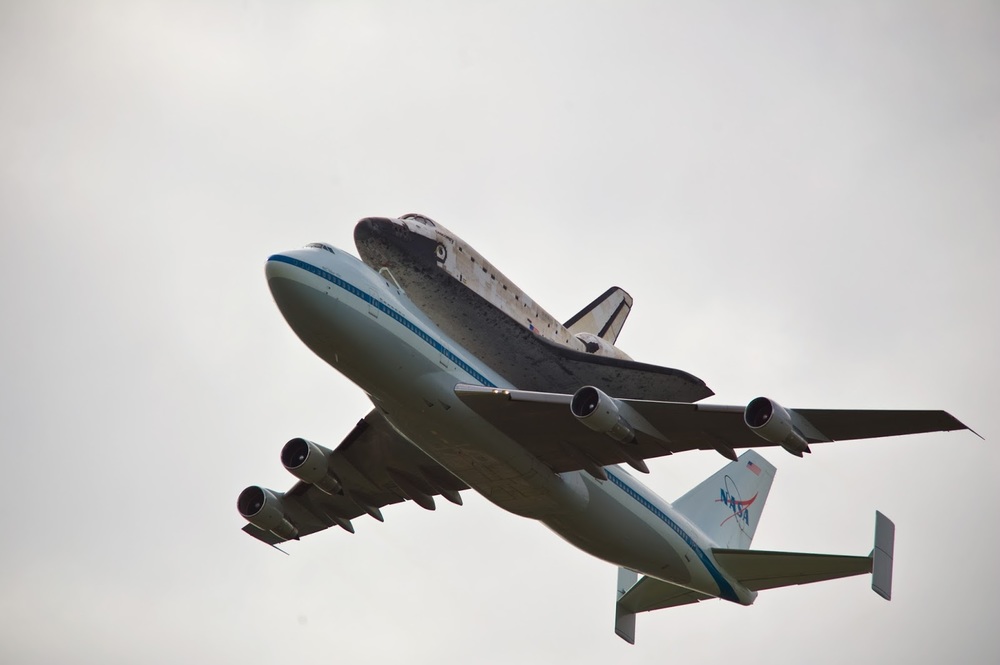
The space shuttle Discovery photographed with a 600mm lens from National Harbor, Md.
Recently I've been thinking more and more about the idea of previsualization, or previsualizing a certain photograph prior to an assignment. I never thought much about this before, however, prior to the last five or six assignments I've had a pretty clear idea of what it was I wanted to capture and then actually did capture that.

Maybe it's because I've photographed the same event year after year, so I pretty much know what to expect and then I just place myself in the right location and wait for the action to unfold. And recently photographing the shuttle Discovery as it flew over Washington, D.C., I was able to get pretty much the exact photo I had in mind. There wasn't any pressure since I was not on assignment to get this particular photo, so all I had to do was put myself in the right position, with the right equipment, to capture the previsualized photo as events presented themselves.

In this case I was assigned to photograph the Sea Air Space Exposition at the National Harbor, something I've done the previous three years, so I knew there were parking garages that would probably give me a good vantage point looking over the Potomac River. When it all came together I quietly thought to myself that this is exactly what I wanted, exactly as I had previsualized.

This photograph did catch me a bit off guard when it came from behind me and passed almost directly over my head.
Perhaps I've always done this. What I think is different now is that even though I have a pretty good idea of what photographs I want, I don't get discouraged if it's not happening as I envisioned. Even though I previsualize, I don't lock myself into what I thought was going to happen, so if things really start to go south, I don't come back with nothing. That is both frustrating and challenging at the same time.

So now previsualization has become part of my overall preparation, normally while going about all my other pre-assignment routines like packing gear and making travel arrangements. It's all about focusing on one assignment at a time.

Ansel Adams used previsualization as it related to the Zone System, the notion that if you study a scene and really analyze the tones, the photograph will come out as you expect. It was a turning point in his career. Of course I'm not shooting with an 8x10 view camera, or even comparing myself to Adams, but if previsualizing a photograph was good enough for him, then I believe I'll continue the practice it myself.

DAM!

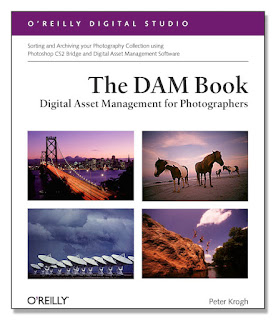
Peter Krough's 2005 version of "The DAM Book"

Not damn, but DAM, as in digital asset management. From the early years during the transition to digital I was fortunate to work around a lot of smart people who really understood workflow and asset management, and even today, I still take pride in my digital workflows even though my asset management could use a bit of refinement.

I bring this up because I was watching TWIT Photo and the guest was Peter Krough who literally wrote "The DAM Book." I didn't recognize the name immediately and actually put off watching the episode for a few days. When I finally got around to watching and realized he was the author (I really only needed to look over at my book shelf to see the 2005 version), I started to pay closer attention.

However, instead of learning more about DAM, like so many photographers today, Peter's willingness to share all kinds of information via his blog and through sites like dpbestflow.org and shutha.org is what had me paying close attention. The Lightroom tutorial on shutha.org is simply amazing and the first time I began to understand the library module and how asset management works within this program. So many tutorials I've watched skipped over this part and spent most of the time in the develop module, so it was refreshing to hear someone go into such depth on what for me was the real barrier to using Lightroom.

I love learning new things and challenging myself to change, even when what I've been doing still works. And even if most of what I do daily can be accomplished in previous software versions of Photoshop and Lightroom, it sure is easier and faster to get great results in the newest versions.

Check out Peter's site and the other sites mentioned above, but most of all, get off you DAM ass!

Remix Alot


Everything is a Remix Part 1 from Kirby Ferguson on Vimeo.

I know I'm late to the game on this one, but I was checking out the blog of Vincent Laforet and his most recent post about Kirby Ferguson's "Everything is a Remix" series of videos. I'm late because Part 4 was released last month.

All that aside, I went back and watched the first four parts and was really amazed by the content and concepts presented. Really thought provoking stuff on copyright, reuse, credit, etc.

"FrankenVideo" is a term I've used for the past couple of years to describe what I sometimes find myself doing in my job with the Office of Naval Research. Much like the Frankenstein monster who was made up of many parts, most of the requests for videos I get are made up of many file formats and come from multiple sources. My job is to rearrange them to tell a coherent story. Additionally, copyright never seems to be an issue until I bring it up. Piecing these videos together is laborious, mostly because of the constraints of government oversight of the computer systems, along with unreasonable time frames. I get the job done, but just like making sausage, you don't want to know how I made it.

Not entirely the same as Ferguson's Remix series and I as I write this, maybe it is nothing like the series at all, however, there is one similarity. I do manage to take lots of parts of existing work and fashion an entirely different product. And much of the work is already publicly released, or even produced in house, so in that sense we are protected from copyright infringement. But what if a snippet here or there was from a copyrighted source?

Take the time to check out the entire series by visiting Ferguson's blog. Watching the series takes no time at all, thinking about the content, well...