PHOTOGRAPHING SUNRISE AND SUNSET - SO WHAT

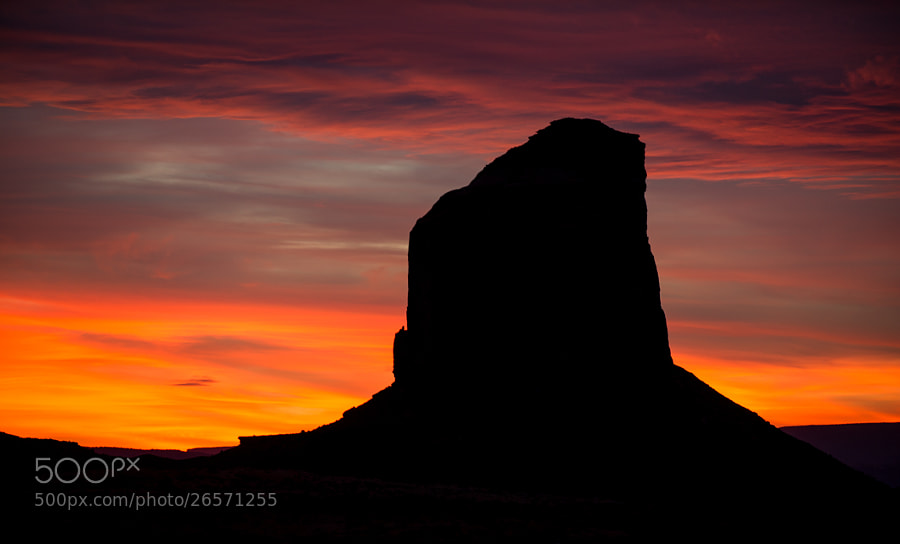
Mitchell Butte sunset in Monument Valley, Arizona. Nikon D3S, 1/15 @ f 4.
The sun sets behind Mitchell Butte in Monument Valley, Arizona, December 2012. Nikon D3S, 1/15 @ f 4.
What am I talking about? I don't want to come off as being anti sunrise or sunset mind you, in fact I enjoy them as much as anyone else. For some reason though, I just don't like photographing them.

Maybe that's a bit of an overstatement, because I do, and have shot them, I mean who doesn't. I talk about light all the time and like most photographers am a big fan of early morning and late afternoon light. In fact, didn't I just write about light in my previous blog post?

And in order to get that great light you normally have to be at a location before the sun comes up and stay after the sun goes down. So naturally you see a lot of sunrises and sunsets.

So why do I dislike photographing them?

Site of the Battle of the Wheatfield at Gettysburg, Pa. Nikon D1H, 1/16 @ f16.
Sunset at the site of the Battle of the Wheatfield, Gettysburg, Pennsylvania, November 2002. Nikon D1H, 1/16 @ f16.
Here it is. It never fails. I'll be showing my photographs to family and friends (normally non-photographers) and the one photograph that elicits the biggest response, tops all others, brings the viewer to their knees is... you guessed it, the sunrise or sunset photo. And I don't know why. Is it because they are so colorful, iconic, romantic, or just harder to capture then I think?

By this point you may be wondering if I'm joking. I'm just wondering how I'm going to finish this blog. Maybe the best way is to get over it, embrace the beauty of it all. Or better yet, maybe I could offer five tips on photographing the rising and setting sun.
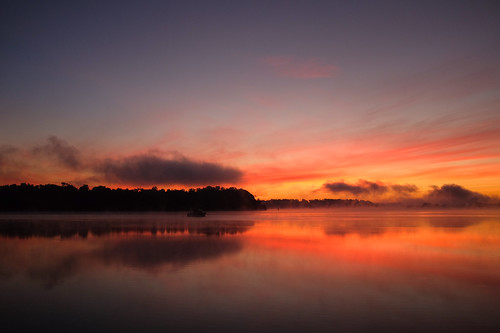
Sunrise on the Sassafras River off of the Chesapeake Bay. Fuji X100S, 1/450 @ f2, exp. comp. -1.0
Sunrise on the Sassafras River off of the Chesapeake Bay, September 2013. Fuji X100S, 1/450 @ f2, exp. comp. -1.0
Here it goes.

1. Turn around. You know that golden light falling on the pond or barn or whatever, well it is coming from somewhere and that somewhere is normally behind you. I've been shocked a few times when I think the light is gone only to turn around and see something amazing.

2. Underexpose. Setting your camera to underexpose the scene by a stop or so will deepen the colors and minimize overexposure of any bright spots. I would also recommend shooting RAW so you have some extra exposure latitude when post processing.

3. Mind your foreground. Putting something interesting in the foreground adds interest and can separate your sunset or sunrise photograph from all the others. Come to think of it, I do like some of my photos when I've incorporated a strong foreground.

4. Wide is fine but think tight. While a wide angle lens can emphasize the grandness, choosing a long lens compresses the scene and if you paid attention to tip number three, then the foreground subject becomes that much more interesting.

5. Bracket, bracket and bracket. You can follow tip number two, but really if there was ever a time to bracket, now is that time. But be mindful of your time, because before you realize it the sun will have risen or set.

Early morning duty in Guantanamo Bay, Cuba. Nikon D1H, 1/4000 @ f6.3, exp. comp. - 0.3.
Early morning duty in Guantanamo Bay, Cuba, May 2003. Nikon D1H, 1/4000 @ f6.3, exp. comp. - 0.3.
So will I stop shooting sunrises and sunsets? No, of course not. Would I prefer to just sit there and enjoy them, probably, but I'm a photographer after all.

CHASING THE LIGHT - AND PHOTOGRAPHING IT

Golden light hits the Chesapeake City Bridge. 1/160 @ f8, ISO 400.
Photography is about light. For me, it's the first thing I see, or don't see, when I'm making a photograph. Good light is why I get up early or stay out late. Light can guide us through an image or place emphasis where we want it. Light is everything in photography.

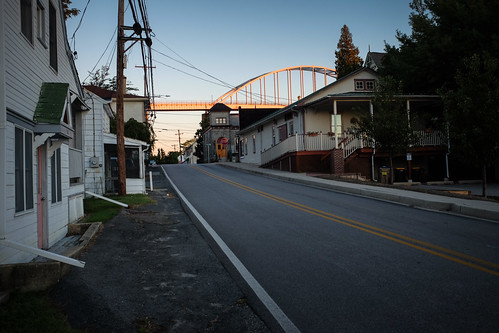
Sometimes light is what makes me grab the camera in the first place. That was the case on a recent morning in Chesapeake City, Md., when on the second day of a three-day transit moving a friends trawler from Cape May, N.J., to Northeast, Md., I found myself awake just before sunrise. I originally had no intention of taking photos that particular morning until I saw the light hitting the Chesapeake City Bridge. This was light, golden light.

Morning Light
The Chesapeake City Bridge and Chesapeake City, Md., are separated by100 years in time but inextricably connected today. 1/105 @ f5.6, ISO 400.
It was around 6:40 a.m. when I grabbed my camera, left the marina and started making my way through the town, pausing to take pictures along the way. Always heading towards the beautiful light on the bridge.

When covering an event I take a picture of the subject, move, take another picture, observe, take another photo and so on, until I feel I have documented everything about the event. My approach to the bridge that morning was no different. Take a photo, move, take another and so on, all the time hoping the golden light would last long enough for me to reach the bridge.

Looming Large
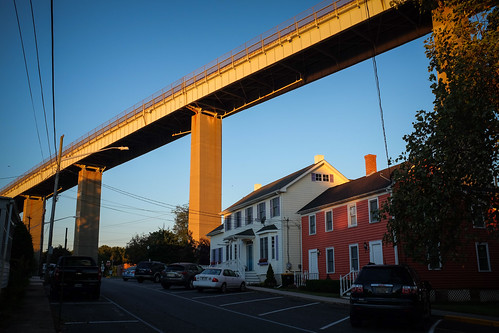
The bridge soars over the historic city and dominates the skyline. 1/125 @ f8, ISO 400.
I was intrigued by how the bridge, which was completed in 1949 and town, incorporated 100 years earlier, seemed connected. I wanted to show that relationship. The bridge dominates the skyline and while the bridge was beautifully lit, the town remained in the shadows. This allowed me to easily distinguish between the two, with more emphasis on the dominating presence of the bridge. Since this bridge soars right over the town, I have a feeling some residents feel that dominance as well, so, in this case, the lack of light on the small historic town is just as important in telling the story. Or at least the story I imagined that morning.

Bridge Base
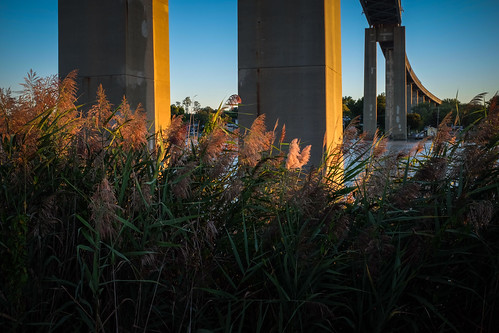
The sun just lights the top of the reeds and provides a nice soft contrast to the hardness of the bridge supports. 1/45 @f8, ISO 200.
Chesapeake City isn't big, so after about 20 minutes I had made it through town and was standing at the base of the bridge. I just keep looking for interesting angles, still concentrating on the light and shadows, but now it was all about the bridge and that wonderful light.

After an hour, the sun had risen high enough that the light which made me grab my camera was gone and it was now time to return to the marina and prepare to get underway. Heading back I still took advantage of some nice open shade and made a few more photographs, but the golden light was gone.

Tractor
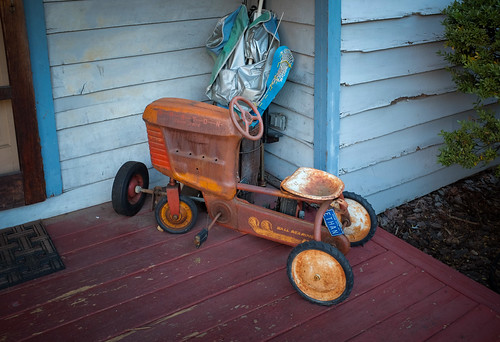
Even though the golden light had passed, the open shade of a porch provides nice even light on this old toy tractor which judging by the license plate is still being enjoyed today. 1/15 @ f5.6, ISO 400.
Seek the light and you just may find yourself grabbing your camera and turning an ordinary morning or evening into an hour long photo walk with magical results.

FUJI X100S AND LANDSCAPES - PERFECT TOGETHER

Even when viewing the results on the back of the camera I knew that the Fuji X100S was capturing the landscape as I was seeing it. 1/1000 @ f8, ISO 400.

Even when viewing the results on the back of the camera I knew that the Fuji X100S was capturing the landscape as I was seeing it. 1/1000 @ f8, ISO 400.

Much has been written about the Fuji X100S and its capabilities as a street camera and the look and feel of this camera certainly can evoke thoughts of roaming the streets in search of light and subjects. And I've previously written on this blog  about getting back into street photography and how I too thought this was the perfect camera.

What is overlooked though is that the quality of the images produced by this camera make it ideal for just about any type of photography, and that includes landscapes as I recently found out after spending a week hiking in the high peaks region of the Adirondacks.

This camera excels in black and white mode. I have added a custom setting for black and white so that I can quickly transition when the mood strikes me. 1/550 @ f8, ISO 400.

This camera excels in black and white mode. I have added a custom setting for black and white so that I can quickly transition when the mood strikes me. 1/550 @ f8, ISO 400.

For this trip, I was prepared to take my DSLR, assorted lenses and tripod. But the more I thought about that, it became clear that this trip was more about getting away and while I enjoy taking photos outside of work, I didn't want to put the pressure on myself that sometimes comes when I bring all my gear. And after all, one of the reasons I decided to purchase the X100S after reviewing it for ten days was because the quality rivaled my DSLRs.

Rocky Falls is a two-mile hike from the Adirondack Loj. Hand holding the X100S was easy even with a slow shutter speed in order to add motion to the waterfalls. 1/25 @ f16, ISO 200.

Rocky Falls is a two-mile hike from the Adirondack Loj. Hand holding the X100S was easy even with a slow shutter speed in order to add motion to the waterfalls. 1/25 @ f16, ISO 200.

Because of the size and weight, I was able to carry this camera over my shoulder while hiking and by running the camera strap through a carabiner attached to my backpack harness, I did not have to worry about the camera hitting the ground if it happened to slip off. Another reason it stayed on my shoulder is that I replaced the manufacturers strap with a double-sided non-slip strap from Think Tank Photo.

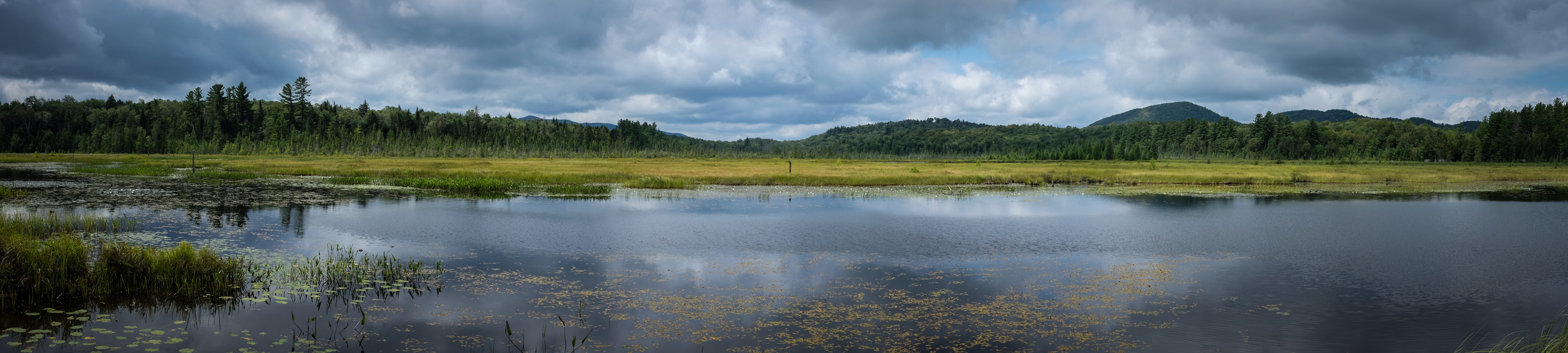
Panoramic view of Heron Marsh located at the Paul Smith's College Visitor Interpretive Center. I'm sure this would be spectacular with early morning or late afternoon light, but the X100S did just fine at noon. 1/850 @ f8, ISO 400.

Panoramic view of Heron Marsh located at the Paul Smith's College Visitor Interpretive Center. I'm sure this would be spectacular with early morning or late afternoon light, but the X100S did just fine at noon. 1/850 @ f8, ISO 400.

This was also the first opportunity I had to really use the panoramic settings on the camera and was impressed with the results. The features are not much different than other cameras, but the setting is easy to get to quickly and understand. You decide camera orientation and direction of the pan, along with how many degrees you want to cover. Once set, you pick the starting point, press the shutter and the camera provides visual cues needed to maintain the correct speed as you complete the pan.

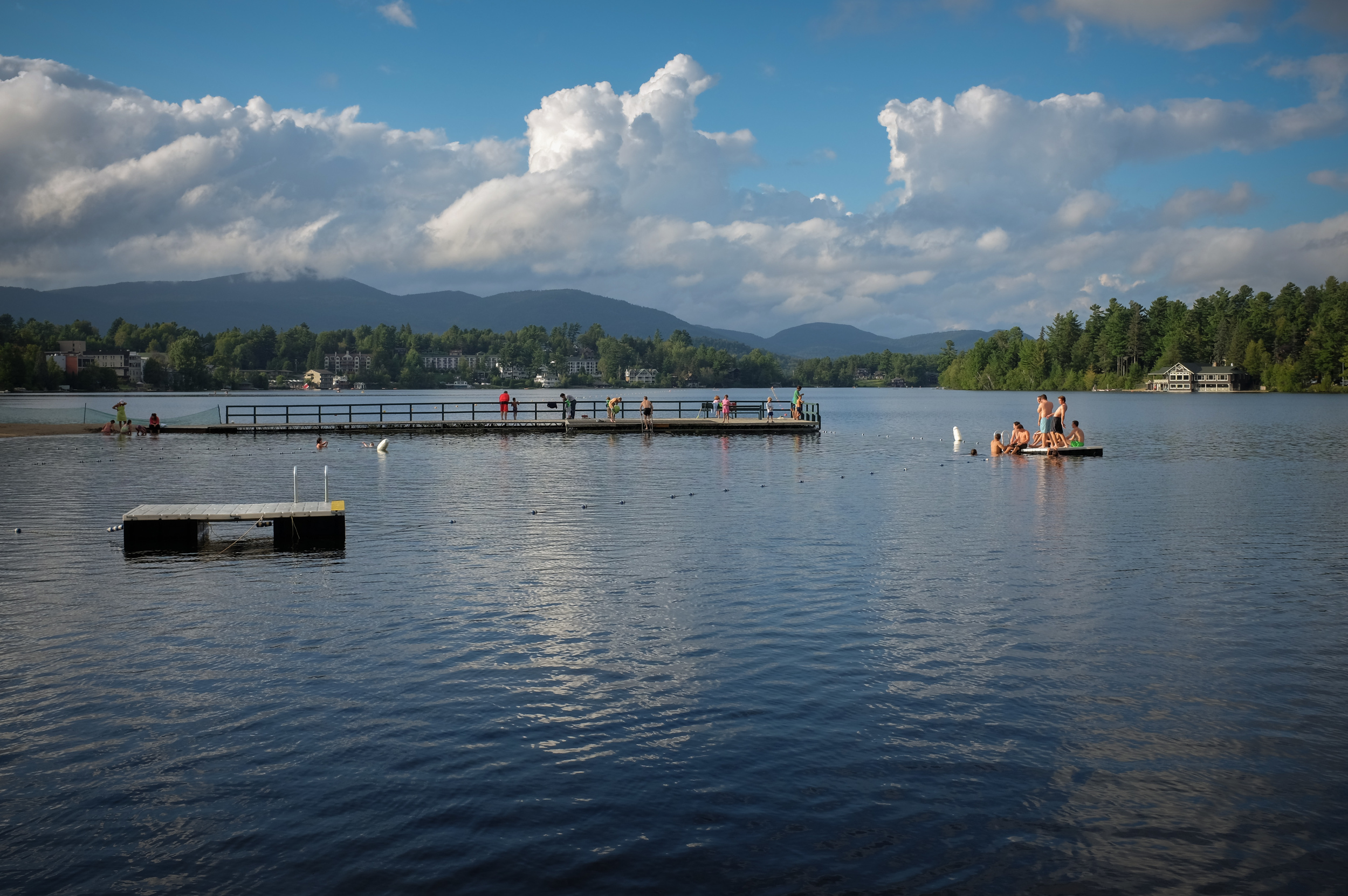
The early evening light highlights swimmers at the public beach on Lake Mirror located in Lake Placid, N.Y. 1/300 @ f8, ISO 200.

The early evening light highlights swimmers at the public beach on Lake Mirror located in Lake Placid, N.Y. 1/300 @ f8, ISO 200.

Something else that really impressed me was that almost all of these photographs were made between 10 a.m. and 3 p.m., normally not the best time to photograph landscapes. So what did I do to make up for the lack of golden hour light? Well not much, but nature did help by providing cool crisp air, nice big clouds and plus I underexposed most shots by a third to one full stop. This helped deepen the colors, eliminate bright spots and add some contrast.

Lake Placid, N.Y.  1/1100 @ f8, ISO 200.

Lake Placid, N.Y.  1/1100 @ f8, ISO 200.

All of these photos did pass through Adobe Lightroom 4, however only minimum corrections were applied. The results straight out of this camera are so close to perfect, post production is a breeze.

So while I don't think the Fuji X100S will replace my DSLR camera for all my landscape photography, it was an attractive alternative knowing I had miles to hike and was looking to shed some pounds. I think the results speak for themselves.

Previous Fuji X series cameras posts:

TEN DAYS WITH THE FUJI X100S

TIME FOR AN UPGRADE? FUJI X10 or X100S

INTRODUCING MY FUJI X10

FAMILY PHOTOGRAPHS

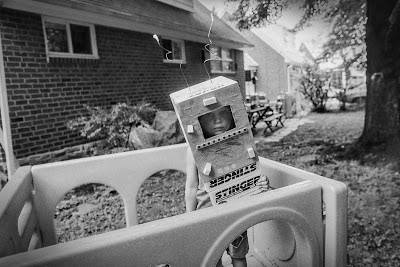
Backyard Astronaut in1994 taken with a Nikon N90 shot on Ilford HP5 Plus. I barely remember taking this photograph, but it has become one of my favorites.
Backyard Astronaut in1994 taken with a Nikon N90 shot on Ilford HP5 Plus. I barely remember taking this photograph, but it has become one of my favorites.
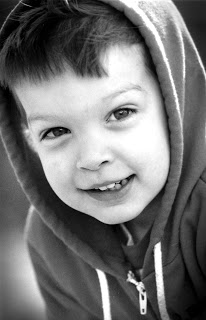
A coworker recently commented that I must have a ton of great photographs of my family, especially my son growing up. I started to wonder if that was true. Did I really document my family the same way that I photographed assignments around the world or even in my own backyard?

Nikon FM2 shot on Kodak Tri-X. There was a time when my family would not run or cover their faces when I pulled out the camera.
Nikon FM2 shot on Kodak Plus-X. There was a time when my family would not run or cover their faces when I pulled out the camera.
If you ask my family I think they would say that I didn't photograph enough. I would counter that they just didn't always see the final results. This became apparent to me recently when I was digging under the eaves in search of some old darkroom equipment for a pinhole photography project and came across dozens of boxes and binders full of negatives and slides.
WARNING: Don't go digging out those old slides and negatives unless you have hours to spare, because once you start going down memory lane, it's a long journey.
I also tried to rationalize that when the family is talking about missing photos, most often they are referring to formal portraits. And it is true that at some point my family just wasn't going to sit for portraits as I tested new lighting or posing techniques. Plus, I figured that I always had an out since there was the school pictures that documented each year thus leaving me with the much more prestigious job of documenting everyday life.

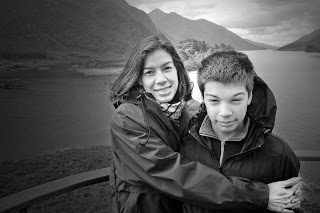
Scotland Vacation in 2004 taken with a Nikon D2H. Found this file on a CD-ROM backup.
So looking back, how did I do?

Well for the answer to that question I'll refer to all those negatives and slides. Apparently I took more photos than I realized of my family and have taken great delight in converting them to digital and sharing, many for the first time. (Learn how I convert negatives and slides to digital files in my post, GRAB A LOUPE - A NEW YEAR WITH OLD NEGS). I also pulled out that collection of CD-ROMs that were at one time my digital backups, but over time and after some hard drive failures, had apparently become the primary files. Another word of caution, get those photos off those disks and back on hard drives with another copy in the cloud.

College Graduation 2013 with a  Nikon D3S. One of two frames I was able to get before I was told that was enough. Some things never change.
College Graduation in 2013 taken with a  Nikon D3S. One of two frames I was able to grab before I was told that was enough. Some things never change.
If your family is giving you grief about not photographing enough of... well the family, ask yourself if perhaps what they are really asking is to just see the results. I'm not talking about sharing what's on the back of your camera, handing them your cell phone or even what's plastered all over social media. I'm talking about making a print, putting it in a frame and hanging it on a wall or placing it on a table. Or if you are really ready to share, then why not upload your files to a service that will make 4x6 inch prints for under 15 cents each that you can then put in an album. Remember those.

That's what memories are made of. Or what memories can still be made of.

HIPSHOTS

STAIRWELL - Nikon 70-200 at 116mm, f3.2, 1/100, ISO 2000.
What are Hipshots? You know that unmistakable sound of the shutter releasing when the camera is no where near your eye; well that is what I am calling a Hipshot*.

This normally happens to me when I'm carrying two cameras and the one hanging over my shoulder knocks against my side, or Think Tank belt system, etc., causing the shutter to release and giving me a wonderful photograph of the ground beneath my feet.

OUTFIELD - Nikon 70-200 at 200mm, f2.8, 1/2500, ISO 400.
This isn't a new phenomenon, however a few months ago when downloading photos from a corporate kickball game a few of these Hipshots caught my eye. So instead of deleting them and moving on, I decided to save them to a folder and make a point of saving others from my assignments.

INFIELD - Nikon 70-200 at 190mm, f3.2, 1/2500, ISO 400.
I also started looking at them closely and thought they weren't half bad. Art? I'll let others be the judge of that.

Five tips on avoiding Hipshots:

1. Turn your camera off when not actively shooting.

2. Don't carry your camera over your shoulder, but instead leave it around your neck.

3. Use an across the chest strap such as one from BlackRapid to reduce the risk of the shutter knocking against your side since the top of the camera is facing down.

4. If you don't want to turn your camera off or carry it around your neck, be aware that it might occasionally go off without your knowledge. Could be embarrassing in some situations, especially if you are shooting in continuous high shutter mode. Nothing draws attention to you like firing six frames per second at the wrong time.

5. Ask yourself if you really want to avoid them? Don't sweat it and just accept the results. Modern painter and artist Bob Ross was famous for saying, "We don't make mistakes; we just have happy accidents".

PAVEMENT - Nikon 24-70 at 52mm, f2.8, 1/3200, ISO 200.
Don't be afraid to have a few "happy accidents" today and if you do, feel free to share them with me. And besides, I believe most of these photographs are as good as anything I see on Instagram.


*All the Hipshots in this post are shown just as they came out of the camera.