WHEN OPPORTUNITY KNOCKS, SHOOT - PHOTOGRAPHING THE SECOND AVENUE SUBWAY

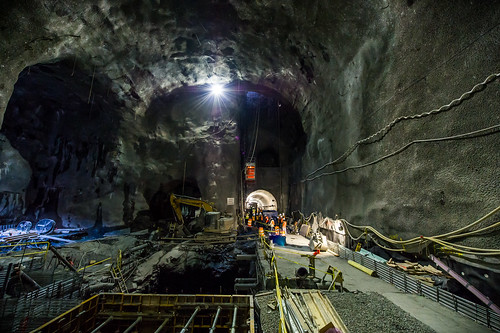
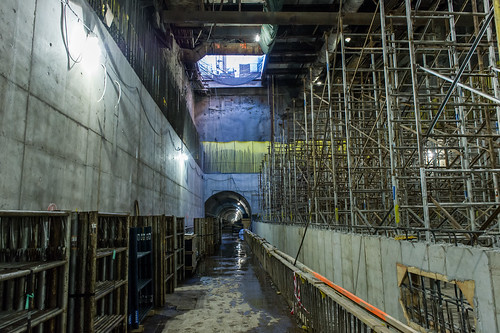
Future 86th Street Station is part of the Second Avenue Subway project.
The future 86th Street Station is part of the Second Avenue Subway project in New York City.
As a photographer for the Office of Naval Research I often have the opportunity to photograph some pretty cool things. Most of the time it comes down to access. If you think about it, as photographers we are often provided access not available to the general public, so when an opportunity arises to photograph something unique, we take advantage of it.

And sometimes opportunities arise because we know the right person. That was the case recently when I had the chance to photograph the Second Avenue Subway Project currently under construction in New York City.

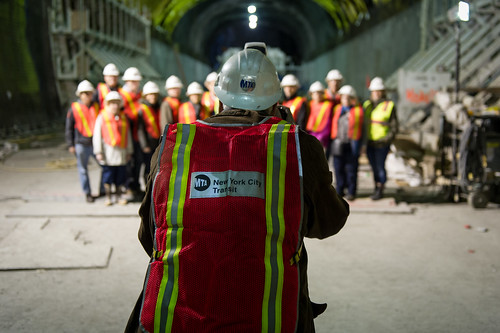
Patrick Cashin, a photographer with the MTA, takes a group photo of neighborhood residents affected by the construction during a tour of the project.
A group photo of neighborhood residents affected by the construction is taken as part of their tour.
My good friend Patrick Cashin, Navy and Air National Guard veteran, is a photographer with the Metropolitan Transportation Authority and is responsible for documenting all aspects of the New York transit system. Part of that documentation includes major construction projects and his recent work photographing the Second Avenue Subway Project is amazing. Pat has never been one to brag, so when he sent me an email earlier this year with a link to a feature that Flickr did on him, I was awed by the work and his story behind it.

Major construction and blasting is completed for phase 1 of the project.
While major construction and blasting is completed for phase 1 of the project, scenes like this still serve to offer a glimpse of what it takes to create new stations and subway lines.
The very first thing that caught my eye when I saw Pat's photographs was the shear scale and size of the project and how some of the photographs he captured looked like they could have been taken 100 years ago when the first subway was built from City Hall to the Bronx.*

So last month as I was planning my trip to New York City for Photo Plus Expo, I made plans to meet up with Pat, even if only for a quick lunch or dinner. He responded that he was also attending the expo, but the real surprise was that he asked if I would be interested in joining him on an assignment the next day photographing underground. Better yet, he had secured permission for me to photograph as well.**

Typically only residents of the neighborhood affected by the project are given the chance to tour the project. One restriction, however, is that they are not allowed to take photographs, which is why the MTA provides a photographer to both document the tour and take a group photo.

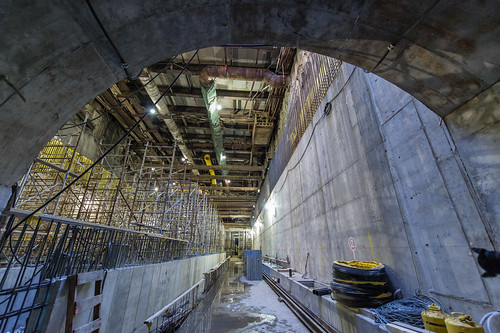
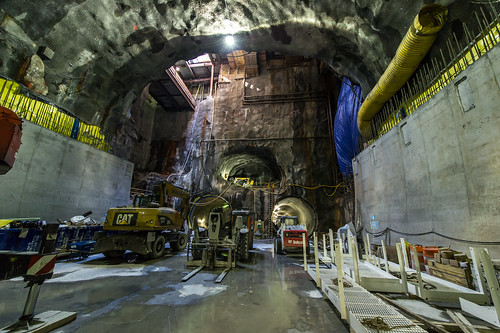
View of the future 96th St. Station. Mixed light made some color correction during post processing a must.
View of the future 96th Street Station using the train tunnel to help frame the shot.
There were two tours scheduled and I would be able to stay underground with Pat between those tours, giving me a total of about three hours to take photographs.

For gear I was pretty sure of two things. That it was going to be dark and that I wanted to shoot wide, so I brought with me the Nikon D3S along with two lenses, the 14-24mm and 24-70mm. And of course I also had my Fujifilm X100S . I knew that light would probably be the biggest issue. I didn't bring a tripod so I relied on the high ISO capabilities of the Nikon D3S to capture the scene. The trade off of course is noise. I processed the images using Lightroom 4.0 where besides some color correction, I opened up the shadows and ran some noise reduction. But for the most part a little noise in these types of photographs does not bother me. With few exceptions I set my ISO to 3200 and everything was shot RAW.

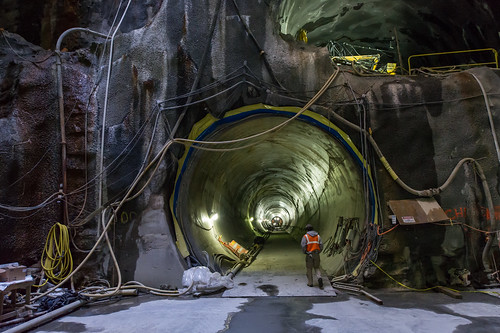
Including a MTA employee helps to show the scale of the subway tunnel.
Including a MTA employee in the photograph helps to show the scale of the train tunnel located at the south end of the future 86th Street Station.
Once underground I really was struck by the size of the project, but how do you translate that in your photographs? Using a wide angle lens and including people is a great way to give the view that sense of scale. Even though this was Saturday and there was not any work going on, I was able to include a few workers who where on hand mostly for safety reasons.

An opening to street level allows some natural light into the future 96th Street Station.
An opening to street level allows natural light into the future 96th Street Station which created some challenging mixed light situations.
Another challenge was the mixed lighting. It turned out to be a bit of daylight mixed with fluorescent and who knows what else. In situations like this I always shoot both JPEG and RAW which then gives me the option to color balance after the fact. Why both? Most of the time I never open the RAW images from an assignment. I think of the RAW files as my insurance, because in reality JPEGs just fit into my work flow allowing me to quickly download, caption and transmit. And in this case I wanted the JPEGs so I could look at and edit a few images on my iPad during the train ride back to Washington, D.C.

The 14-24mm lens allowed me to emphasize the shear size of the project.
Shooting wide with the Nikon 14-24mm lens allowed me to emphasize the size and scale of the project.
Do you have friends or family that can get you access to interesting places? I bet if you think about it, you do. Also think about what you do for a living or something you have access to and if it might be interesting to a photographer friend. We tend to not think of what we do as interesting, but in many cases if you stepped back, you would realize that there might be unique opportunities all around.

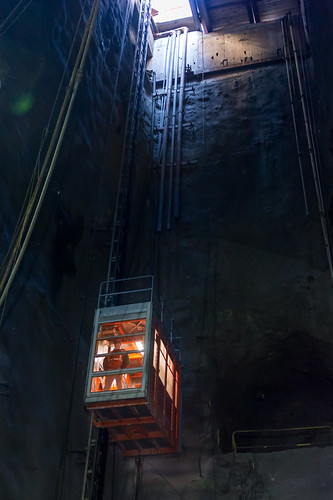
An MTA employee makes the 150' trip to the surface from the 86th Street Station.
An MTA employee makes the 150' trip to the surface from the future 86th Street Station.
MTA on Flickr:
Metropolitan Transportation Authority of the State of New York

*This project was originally proposed in 1929 as a major expansion, although work never commenced due to the Great Depression. Digging for the project did begin in 1972, however it only lasted a few years before New York became insolvent. Ground breaking for the current project happened in 2007.

Phase I of the current project begins at 96th Street then runs south where is will join the existing 63rd Street Line. Additionally, three new stations will be located at 96th Street, 86th Street and 72nd Street. I entered the project via 125 foot elevator at the 86th Street location and then walked underground via the rail tunnel to the 96th Street station and back.

**In order to photograph the project I had to sign an agreement with Capitol Construction limiting my use of the photographs and while I do retain copyright, I am unable to license them for commercial use. For all inquiries about photo use, please contact Rosanna Alcala at ralcala@mtacc.info.

BREAKING THE AA BATTERY CYCLE


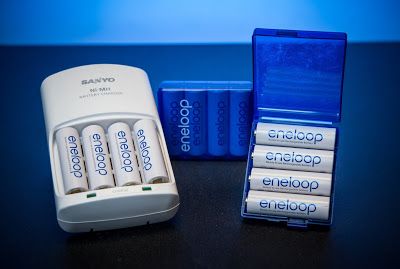
Sanyo eneloop rechargeable batteries, charger and case.

Batteries are key to all things digital.

About seven months ago I decided to stop the endless cycle of purchasing AA batteries and made the switch to Sanyo's eneloop Ni-MH rechargeable batteries for use in my strobes.

There are plenty of rechargeable battery options out there, but so far I have not had any issues using these in my Nikon SB900 and SB910. I also have been using them in my wireless keyboard and mouse.

Upfront they are more expensive than traditional AAs, but if you have ever had to run into a convenience store on the way to an assignment, then you know that isn't always the case. Given that scenario, spending $12.99 on a 4-Pack of rechargeable AA's  seems like a bargain, right?

Things to consider if you make the switch.

1. Buy enough rechargeable batteries so you can eliminate the need for traditional batteries altogether.
2. The batteries come pre-charged and are ready for use right out of the pack.
3. Once charged, the manufacturer claims the batteries will hold that charge for three years.
4. While initial cost is more, they pay for themselves quickly.
5. You have to carry another charger and remember to use it.

I recently read a great tip for organizing your rechargeable batteries over on Joe McNally's blog. To avoid mixing charged and depleted batteries use two pouches, such as Eagle Creek Pack-It Sacs, one green for charged batteries and red one for depleted batteries. If you can't find red and green, then really any two colors will work as long as it makes sense to you.

Final word of advice if you decide to make the transition. Habits are hard to break, so be careful to not throw your new rechargeable batteries in the trash. The best case is that you realize it and have to simply dig through the garbage, worse case, it becomes an expensive mistake.

Finally if all goes wrong, there is always that convenience store.

IS THAT A LEICA?

My Fujifilm X100S complete with gaffers tape.

My Fujifilm X100S complete with gaffers tape.

As an owner of theFuji X100S for the past five months I've heard that question more than a dozen times. Second only to "Wow, do you still shoot film?"

It's a fair question. The Fuji X100S does somewhat resemble the Leica digital M9 or the M3 film camera and maybe that was what Fuji designers had in mind.

Somehow I think the X100S secretly likes this question. It's like watching a cover band that sounds just like the real thing and knowing that I only had to pay a fraction of the cost and had just as much fun. And just maybe that cover band breaks out and becomes famous on their own one day. Then goes from famous to classic.

Steam Whistle Brewery in Toronto, Canada.

Steam Whistle Brewery in Toronto, Canada.

The first time I heard this question was in Toronto, Canada, during my first ten days with an X100S I rented from Borrowlenses.com. My guide during a beer tour (on the record, this was a personal shooting assignment) of the city actually combined the top two questions by commenting how cool that I was both using a Leica and shooting film.

Heron Marsh Trail in the Adirondacks, New York.

Heron Marsh Trail in the Adirondacks, New York.

A couple of months later on a trail in the Adirondacks as a couple approached I could see the husband eyeing my camera. Just as we came together he commented that it had been a while since he had seen someone using a Leica. What really made this special was that he asked that question with a heavy German accent.

Red scooter and sign in Brussels, Belgium.

Red scooter and sign in Brussels, Belgium.

In Brussels, Belgium, as I was checking out of the hotel the desk clerk clearly was talking about something other than my bill. I was having a bit of trouble understanding him with his French accent until I heard the word Leica. Then it was clear, he was telling me that he hoped one day to afford one. Once again I took great delight in showing him that it was not a Leica, but in fact, the new Fuji X100S. Score one for international relations.

Randy's Donuts in Inglewood, Calif., near Los Angeles International Airport.

Randy's Donuts in Inglewood, Calif., near Los Angeles International Airport.

Then just the other day on the shuttle from the rental car agency to LAX I could feel the man across from me looking at the camera in my lap and sure enough, he finally asked which Leica I was carrying. I'm not sure even now he believes me that it was not what he thought it was.

Perhaps the 10mm red metal soft shutter release button I've recently added subliminally makes one think of the Leica emblem. Given that the red shutter button costs 96 cents,* combined with the $1,299 price of the X100S, I have a few more cameras to buy before my Leica 'impostor' equals the cost of an actual Leica M9. But this classic is mine.

*While the button costs $0.96, there is a $4.99 shipping cost. Also, there seems to be an issue losing the button which did happen to me, although I was lucky enough to find it in the bottom of my bag. I have since used super glue.

TAKING THE FUJI X100S TO THE STREET

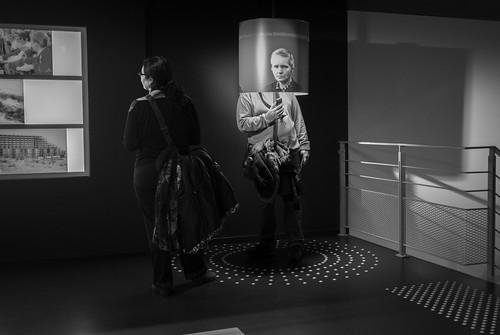
Tour of the Parlamentarium at the European Union in Brussels Belgium.

The Parlamentarium. 1/13 @f2.0, ISO 1600.

The lure of street photography for me is all about the moments, moments that happen hundreds of times a day, happen all around us and happen in an instant. Moments that happen whether you are there with your camera on not.

The goal then is to capture those moments. To do that you must be aware of what is happening around you and be ready with your camera at all times.

I mentioned in the blog post

Ten Days With the Fuji X100S

 that if I wanted to use this camera on the streets I was really going to have to spend some time becoming familiar with it. Along the way I've missed plenty of those moments though. That's natural. With any new camera or piece of gear, you have to use it and use it over and over so that operating it becomes second nature. This is especially true in street photography.

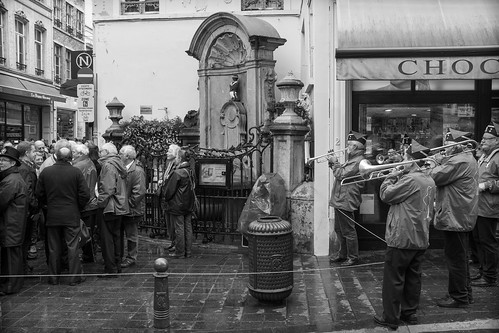
Manneken Pis

Patience allowed me to capture a clear shot of the Manneken Pis framed by a band and officials during a ceremony. 1/140 @f8.0, ISO 400.

Fortunately, the learning curve is not steep with this camera and after four months of shooting, including these photos from three days in Belgium and one day in Amsterdam, I've come to appreciate the challenges as well as the positives shooting with the Fuji X100S .

What you see.

I use the optical viewfinder (OVF) display instead of the electronic viewfinder (EVF) which means there is no display lag when I bring the camera to my eye and it also gives me a larger field of view than that of the lens. This means I can keep track of what is happening just outside the frame without ever removing my eye from the viewfinder.

However, there is still a second or two lag before you are able to release the shutter, especially when the camera has gone to sleep. One way I overcome this lag is to keep the camera turned off and then turn it on as I bring it to my eye. Using this technique, I have found the camera seems to be ready to shoot as soon as I get it to my eye.

Take time to stop and just wait for things to happen. I was originally photographing the two women window shopping for chocolate in Brussels when a mother and child exited.

Take time to stop and just wait for things to happen. I was originally photographing the two women window shopping for chocolate in Brussels when a mother and child exited. 1/50 @f5.6, ISO 400.

Again, in street photography you have to be ready for that moment and a second too soon or too late makes all the difference.

Monochrome or color?

One thing that I really like about the X100S is the monochrome film simulation mode and the quality of those black and white images right out of the camera. For me black and white and street photography go together, so one of the first things I did was set one of the custom functions to monochrome, which then made it easy to switch between modes. I soon found that switching between modes throughout the day takes both time and can compromise creativity. That was until I inadvertently found a solution.

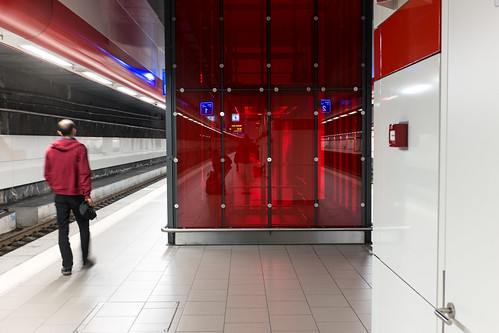
This scene at the Brussels airport train station is all about the color. Shooting JPEG plus RAW meant I had the color data available to me even though I had the camera set to monochrome.

This scene at the Brussels airport train station is all about the color. Shooting JPEG plus RAW meant I had the color data available to me even though I had the camera set to monochrome. 1/9 @ f4.0, ISO 800 +0.33EV.

Initially I was only shooting in JPEG FINE mode, however more recently I have been shooting JPEG FINE plus RAW allowing me to keep the camera set to monochrome, stay in that frame of mind creatively, all the while knowing that there is a RAW file containing original data, including color information. If I come across a scene where color plays a part, I can take the photo without having to go into my custom settings.

This scene at Amsterdam's Central Station is all about the color. Shooting JPEG plus RAW meant I had the color data available to me even though I had the camera set to monochrome.

This scene at Amsterdam's Central Station, like the photo above, works because of color. Again, I knew it was about color  even though the camera was set to monochrome, but not having to switch saved me time before the buses moved and the moment passed. 1/160 @f2.8, ISO 400.

Size matters.

The Fuji X100S' size and feel are perfect for street photography. Not as threatening as a full frame DSLR with lens, the X100S presents itself well and feels right in your hands. When walking the streets I like to wrap the camera strap around my hand and carry the camera at chest level so when I see a scene developing, I'm only seconds away from being ready to shoot. I've also added the Fotodiox Pro Thumb Grip which helps me hold the camera securely. Then once I start shooting, I keep shooting and moving in order to get the best possible picture.

Even when noticed by the subject, I'm not given the same look as if I was pointing a large 'professional looking' DSLR camera at them. The added advantage on this camera of having a preview appear in your viewfinder means you know what you are capturing without having to remove your eye from the viewfinder.

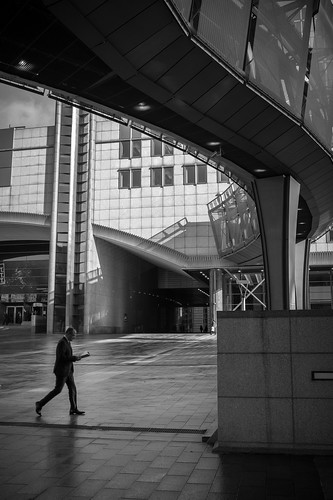
Outside the European Union in Brussels. I liked the shadow and shapes created by this overhead walkway, so I waited until a person walked by. Timing is key and if I waited for the subject to take one more step this would have been a stronger image.

Outside the European Union in Brussels. I liked the shadow and shapes created by this overhead walkway, so I waited until a person walked by. Timing is key and if I waited for the subject to take two more steps this would have been a stronger image. 1/100 @f8.0, ISO 200.

And since the X100S doesn't draw any attention to itself (from non-photographers anyway) I also find that I'm able to shoot in locations that I would previously have had to worry about being stopped and questioned like a mall or store.

I don't think I ever had any real doubt that this camera would be a perfect street camera for me and the more I shoot with it, the more I'm convinced of it. I'm feeling more like a photojournalist then when I actually was a photojournalist. What more can I say.

See you on the street.

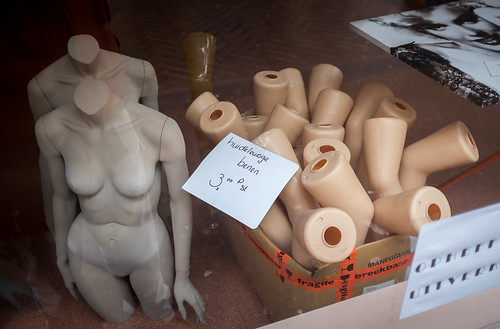
Body parts for sale in an Amsterdam window.

Body parts for sale in Amsterdam window. 1/25 @f2.0, ISO 400.

Previous Fuji X series camera posts:

FUJI 100S AND LANDSCAPES - PERFECT TOGETHER

TEN DAYS WITH THE FUJI X100S

TIME FOR AN UPGRADE? FUJI X10 or X100S

INTRODUCING MY FUJI X10

WORLDWIDE PHOTO WALK WRAP UP

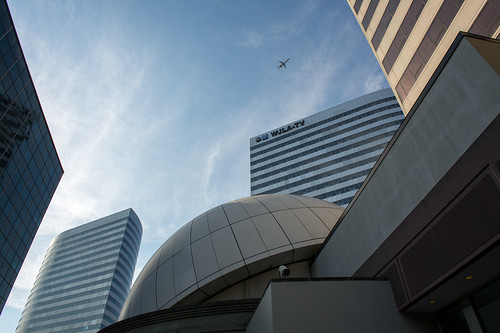
* Rosslyn's skyscrapers are compressed in a very dense area giving it a very urban feel.
* Rosslyn's skyscrapers are compressed in a very dense area giving it that urban feel I was looking for. 
On October 5th I participated in Scott Kelby's 6th Annual Worldwide Photo Walk and wanted to share the experience and talk a little about the walk itself. Last year I was part of a walk around the U.S. Capitol in Washington, D.C., and following that experience decided that I wanted to lead a walk in 2013. Not because it wasn't a good experience, but mostly that I was surprised at the time that there wasn't a walk in Arlington, Va., where I live.

So when the 2013 date was announced I applied to be be a leader and was accepted. Ultimately 12 photographers signed up and I ended up walking with ten.

As I already said, I've known since last year that I wanted to lead a walk in Arlington, so the first thing I needed to do was find a location that would be interesting enough photographically for the two hour walk. Since I live in Arlington, I spend a good deal of time walking around the area with my camera, although most of the time I return home without taking a single photograph, which probably should have been a clue as to why there wasn't a walk here. Well that was what I was thinking until I found myself in Rosslyn one morning and all of a sudden I was seeing all kinds of things to photograph. I knew then that I had a solid location for a walk.
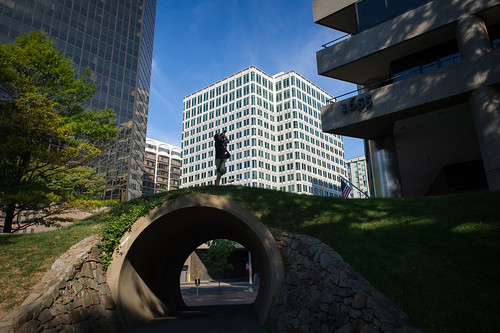
Dark Star Park is just one of the many green spaces located in Rosslyn that I felt offered a contrast to the steel and concrete of the urban landscape.
Dark Star Park is just one of the many green spaces located in Rosslyn that I felt offered a contrast to the steel and concrete of the urban landscape. 
For those that are unfamiliar with Northern Virginia, Rosslyn is located in the northeastern corner of Arlington County just over Potomac River from Georgetown and adjacent to the U.S. Marine Corps War Memorial and Arlington National Cemetery. What I find really unique about Rosslyn though is the many skyscrapers located in a relatively small area making it seem much more urban or city like, even compared to Washington, D.C.

Elevated walking paths and parks are another thing that make Rosslyn unique and provided the perfect route and theme for our walk. The light, shadows, textures, reflections, shapes and contrasts make it an excellent location for photography. While there is no specific theme as part of the Worldwide Photo Walk, as a leader I think it helps to point out why you picked a specific location and share some thoughts about it with your group. Remember that there are all skill levels that will potentially join you and some may be looking for inspiration and ideas.
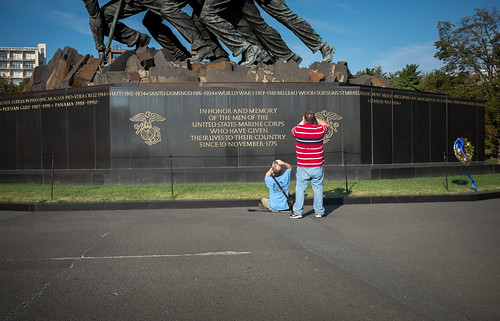
The U.S. Marine Corps War Memorial was a great place to meet and get started on our photo walk.
I choose the U.S. Marine Corps War Memorial as a meeting location, mostly because it is a known landmark, making it easy to find, has open space so I didn't miss anyone as they arrived and most important, there is free parking. The government shutdown meant the parking went away, but I think it was still a good place to meet and take a few photos before we began our urban exploration.
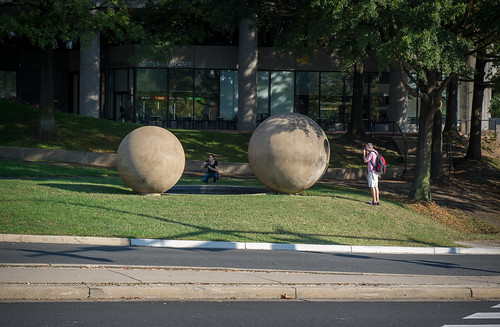
Dark Star Park is a unique space in Rosslyn and worth the visit.
After about ten minutes photographing the U.S. Marine Corps War Memorial, we moved on to Dark Star Park which sits on a small patch of land as you enter Rosslyn from the Fort Meyer area. The park consists of a series of concrete spheres, reflecting pools, a large tunnel as well as steel poles and each year on August 1st, at 9:32 a.m., the sun casts shadows which then align with permanent patterns on the ground. I've always been fascinated by this park and it was the reason I found myself in Rosslyn taking pictures in the first place. And even though it is a very small area, every time I visit I find very different photographs to take and knew it would be interesting for the group.
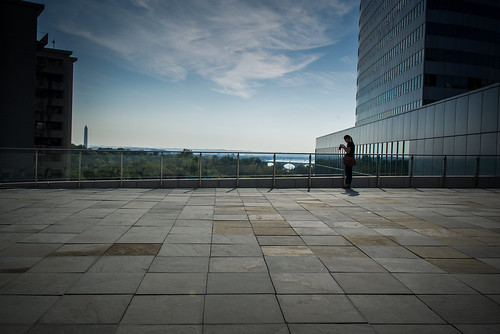
Freedom Park seems to float between buildings and even offers a view of Washington, D.C., and the Washington Monument.
We next made our way through Freedom Park, a two block long elevated park originally constructed as a automobile overpass. This park seems to float between buildings and gives you some excellent elevated views of Rosslyn and even a glimpse of Washington, D.C., in the distance. It is a wonderful place to explore reflections and shadows, concrete and greenery, and depending on the time of day, offers very different looks. Initially the group moved through the park rather quickly which surprised me because I choose this location because of all the angles, shadows and shapes it presented. I then noticed that many went back to the beginning and really began to explore and take that second look. Maybe that is what I did the first time I visited this location, so remember that even if you have explored a location multiple times, this is probably the first time your walkers visited.
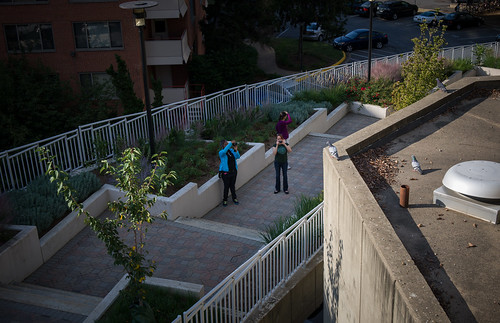
Walkers make their way into Freedom Park. Two entrances to the park did allow walkers to spread out a bit. It is important, especially with a very large group that you give the photographers space to move around and stay out of each others way.
As a walk leader you need to keep the group on pace, but you also don't want to rush anyone, especially if it looks like they are really feeling a location. Two hours goes by fast and while I thought about adjusting the itinerary and ending here, I did push on and the group began to spread out during the transition to the final location which I didn't want to happen. Remember this was only a group of ten, so imagine if you had 30 or even 50 photographers.
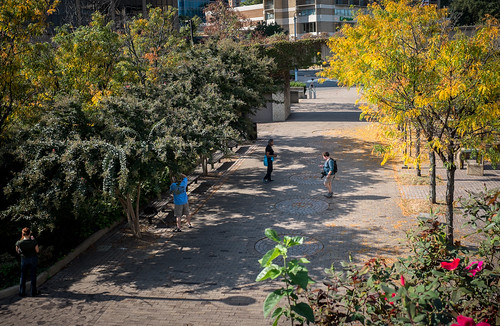
Gateway Park is larger than it first appears and offers lots of spaces to explore with your camera.
Our final location was Gateway park which is located close to the Potomac River and the Key Bridge. This park features a large tiered green space leading into a series of concrete elevations and walkways which again have you looking down on the streets or the park and when followed allows you cross back towards Rosslyn.

It really was a fun day and I enjoyed meeting new people and sharing a few hours with other photographers taking pictures and talking photography. If you have a great idea or location for a walk, I encourage you to apply to be a leader in 2014.
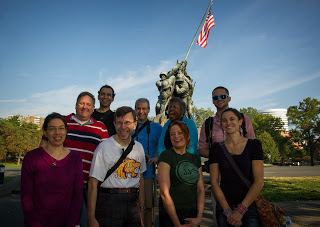
I made getting a group photo right a the start, and then sharing it,  a priority.
I made getting a group photo right a the start, and then sharing it,  a priority.
I already know I want to lead another walk in Arlington and whether I choose Rosslyn again or opt for a different part of the county, I know I'll have all year to explore and figure it out. If you participated in this year's walk, either as a leader or as a participant, and have something to add, feel free to leave a comment below.

2014 by the Numbers: 1238 photo walks, 28456 participants.
More information and FAQ: http://worldwidephotowalk.com/
Worldwide Photo Walk group on Flickr: http://www.flickr.com/groups/wwpw2013/

* This is one of the few photographs I took that day that didn't involve documenting the walk. As a leader I believe you have the responsibility to ensure your walkers are getting the full experience and you can't really do that and spend all you're time shooting. Your time to take photos is when you visit the location prior to the walk which also means you can offer tips and suggestions on what to photograph for those walkers that ask.